Where the word comes from
Coffee reached Sweden in the 1670s and was promptly treated with suspicion. Between 1756 and 1823 it was banned outright five separate times, partly on health grounds and partly because the crown wanted the money spent elsewhere. King Gustav III is said to have ordered a pair of twins to drink coffee and tea respectively for life to prove which one killed you first. Both outlived the doctors supervising the experiment.
Once the bans were lifted, Swedes drank coffee with the enthusiasm of the long-denied. The word fika appears in the early twentieth century as back-slang: take kaffi, an old spelling of kaffe, swap the syllables and you get fika. It is both a noun and a verb. You can have a fika, you can go for a fika, and most naturally of all you can simply fika. "Ska vi fika?" is the most common invitation in the Swedish language, and it means "shall we stop for a bit?" as much as it means anything about coffee.
The unwritten rules
Nobody will hand you a rulebook, but every Swede follows the same handful of conventions without thinking about them.
- It is a pause, not fuel. The point is the stop. Coffee drunk while walking to the metro is not fika, however good the coffee.
- Twice a day is normal. Förmiddagsfika falls around 10:00 and eftermiddagsfika around 15:00. Offices, building sites and hospitals all keep roughly this rhythm.
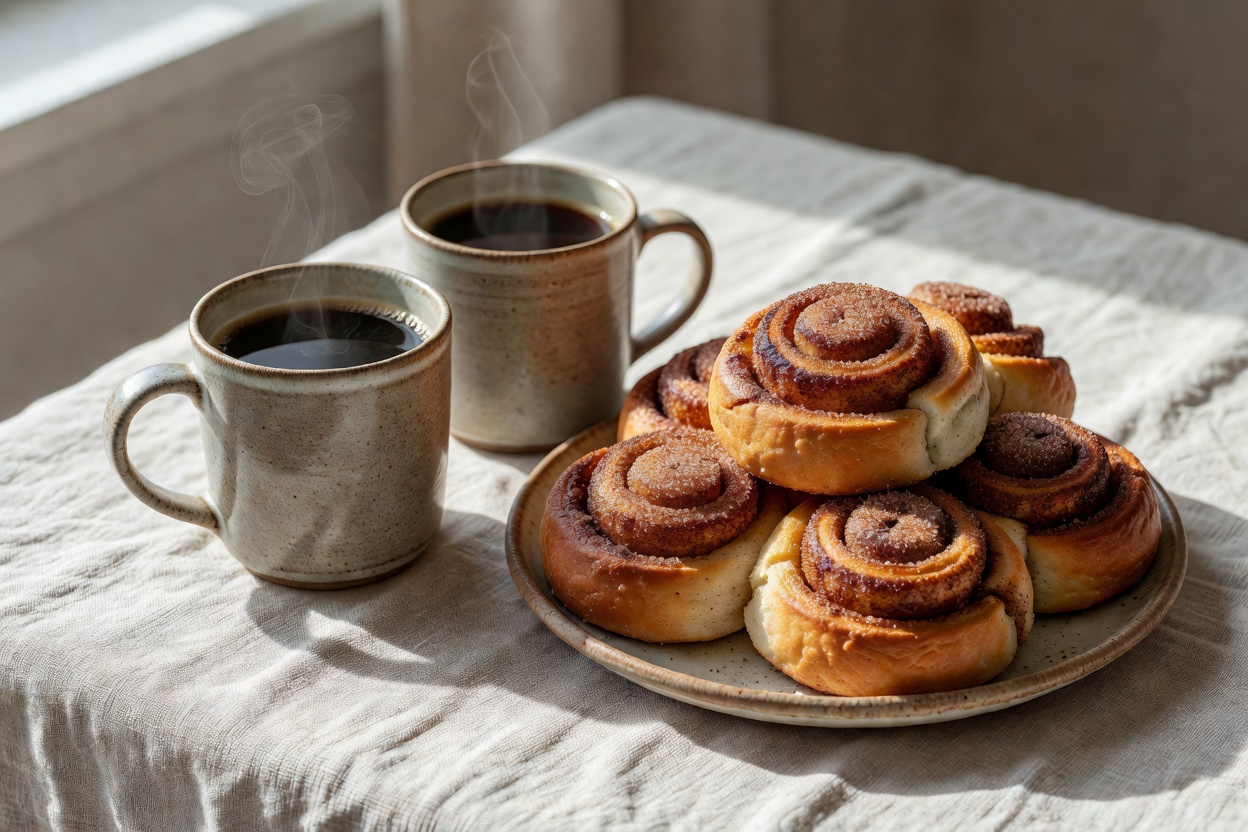
- Something baked is expected. The generic term is fikabröd, literally "fika bread". A bun, a cookie, a slice of cake or, at minimum, a rye crispbread with cheese.
- You sit down. Standing fika exists in emergencies. It is not admired.
- It is egalitarian. The chief executive and the summer intern fika at the same table. Titles are left at the door.
- Phones down. The whole exercise collapses if half the table is scrolling.
Fika versus a coffee break
The difference sounds like hair-splitting until you sit through both. The table below is how we explain it to visitors who arrive expecting a takeaway counter.
| Feature | Fika | Coffee break |
|---|---|---|
| Duration | 15–30 minutes | 5 minutes, often less |
| Company | Ideally with others; solo fika is legitimate but quieter | Frequently alone |
| Food | Expected, and discussed | Optional, and rarely discussed |
| Purpose | Social reset, conversation, a change of gear | Caffeine |
| Location | Away from the desk, at a table | Wherever the mug ends up |
| Drink | Coffee, tea, saft or hot chocolate all count | Coffee |
Sju sorters kakor: seven kinds of cookies
The grandest form of fika at home is the coffee table with seven kinds of small cookies, a convention codified by the 1945 cookbook Sju sorters kakor, which is still in print and still in most Swedish kitchens. The etiquette was precise: fewer than seven varieties was mean, more than seven was showing off, and the guest was expected to try one of each in a set order, from the plainest butter cookie to the richest chocolate one.
The classic seven usually include drömmar (dreams, made with hartshorn salt for a hollow crunch), finska pinnar (almond fingers), hallongrottor (raspberry caves), chokladsnittar (chocolate slices), syltkakor (jam sandwich cookies), kolakakor (caramel cookies) and brysselkex (Brussels biscuits with a pink sugar edge). We bake the full set every Saturday for 14:00 and serve it on a tiered stand for 95 SEK per person, coffee included. Half the room comes for the cookies. The other half comes to argue about the order.
Fika at work: the case for and against
Swedish employers treat fika as part of the working day rather than time stolen from it, and there are decent arguments on both sides.
For
- Problems get solved informally across teams that would never book a meeting together.
- Hierarchies flatten. New staff learn who actually knows things.
- Two predictable breaks reduce the afternoon slump more reliably than one long lunch.
Against
- Two 20-minute breaks are 40 minutes a day, which is three hours a week per person.
- Daily buns add up. Many workplaces now alternate baked goods with fruit.
- Shift workers and remote staff are easily left out of a ritual that assumes shared space.
How we do it at the studio
We designed Scoutshelfstorypuls to make the pause easy. Tables are yours for a comfortable 90 minutes at busy times and indefinitely otherwise. The room goes laptop-free after 11:00 on Saturdays and Sundays so weekend fika stays a conversation rather than a co-working session. Our morning deal, any bun plus a bottomless cup of batch filter for 75 SEK before 10:00 on weekdays, exists because förmiddagsfika should not require a decision.
If you are new to it, order a kardemummabulle, a filter coffee, sit at the communal table and put your phone face down. That is the whole method. Everything else in these guides is detail.